

Visit the SALMON Bookshop for
recommended
books on this topic |
Approaches to
the Study of Aggression
Author
Paul
Kenyon
Neurotransmitters
& Aggression
Hormones
& Aggression
|
Neuropsychology
of Aggression & Fear
|
Overview
An important theme in this lecture is untangling the
relationship between aggression, dominance and impulsiveness. We begin
by looking at studies of aggression - behaviours intended to inflict
damage on another individual - which have been studied from a variety
of different theoretical perspectives.
By
the end of the lecture you should be able to evaluate the explanations
of aggression provided by ethology, behaviourism and evolutionary
psychology.
Hormones,
particularly testosterone are linked in the public's mind to
aggression. But you will begin to appreciate that, although it is
relatively easy to study the effects of hormones in rodents under
laboratory conditions, things prove more complicated when we try to
apply these insights to human behaviour where attempts to achieve
dominance rather than inflict physical harm characterize agonistic
interactions.
Another
emerging theme from this material is that engaging in agonistic
behaviour can influence the chemistry of the body.
The
role of serotonin in agonistic behaviour is introduced in order to make
the point that there is a link between agonistic and impulsive
behaviour, and that aggression is not always directed outwards, but can
lead to suicide. You should begin to appreciate that there are often
links between the topics you study on this course. For example, work on
serotonin and aggression is relevant to studies of the biochemical
basis of depression.
Finally
the lecture describes the role of the hypothalamus and amygdala in
agonistic behaviour. When you study this material you should begin to
see how the topics of fear, anxiety and aggression are interrelated.
The ability to synthesize material in order to see patterns in evidence
is an important intellectual skill that you should try to develop
during your studies.
|
Learning
objectives
After
studying the material on this page you should be able to:
- Distinguish
between aggressive, dominance and agonistic behaviours
- Describe
the components of the Lorenz model of aggression
- List
two predictions made by the Lorenz model
- Evaluate
the strengths and weaknesses of the Lorenz model
- Explain
the advantages of an operational definition of aggression
- Recognize
the categories of aggressive behaviour proposed by Moyer and Brain
- List
the techniques used to study aggression in laboratory animals
- Recognize
the psychological factors thought to be involved in reproductive
success by evolutionary psychologists
- Evaluate
the explanation of aggression provided by ethology, behaviourism and
evolutionary psychology
- Describe
the origin and physiological effects of testosterone
- Describe
the effects of castration and hormone-replacement therapy on aggression
in male and female mice
- Critically
evaluate the evidence of a role for hormones in human aggression
- Evaluate
the relationship between serotonin, aggression and impulsivity
- Describe
the role of the hypothalamus and amygdala in aggression
|
'We
frown on aggression but thrive on
dominance'
 |
Aggression
is overt behaviour intended to
inflict damage on another individual. Human aggression is relatively
rare - when was the last time you inflicted damage on someone, or were
the victim of a physical assault? But it is very likely that you have
been at the receiving end of a person's dominance behaviour.
Dominance
behaviour is designed to achieve, or maintain, high
status - to obtain power, influence, or valued assets - over a
conspecific. It is displayed on our TV screens in programmes such as
"Big Brother".
|
|
|
Tail-gating'
is a threatening form of driving in which a car
is driven close to the rear of the car in front with the intention of
getting the slower driver to move over. Atzwanger (1995) videotaped
drivers when they drove up close to another car. He found:
- Men
drove close up faster than women
- Individuals,
who drove alone, were more likely to tailgate than those with
passengers.
- Drivers
of cars with higher status drove closer up than others.
In
this example we see several themes that will be developed in this
lecture: sex differences in agonistic behaviour, competition for
resources, and impulsiveness in the face of danger.
Humans
use threats and violence to dominate, but we also resort to cheating,
deceit or negotiation to obtain status
and valued resources. In fact a lot of our behaviour involves
strategies for existing with each other without causing or risking
actual physical damage. The TV program 'Big Brother' is an example of
how people compete, co-operate and negotiate in pursuit of financial
reward and status.
The
term agonistic behaviour is a convenient way of
referring to the constellation of 'aggressive' behaviours.
An
important theme in this lecture is untangling the relationship between
aggression, dominance and impulsiveness. We begin by looking at studies
of aggression - behaviours intended to inflict
damage on another individual
|
|
Perspectives
on aggression
Aggression
has been studied from a variety of
different theoretical perspectives. Here is a flavour of three
different approaches:
- ethology,
- behaviouism
- evolutionary
psychology
which
have all offered something important to
our understanding of this topic.
Lorenz
- is aggression inevitable?
 |
In
a previous lecture you learnt about a simple biological theory of
aggression based on Lorenz' theory of motivation.
Lorenz
argued that aggression in animals and humans is an inherited,
spontaneous tendency much the same as the motivation to eat, drink and
make love.
Action
specific energy accumulates in a reservoir until released by the
appropriate external stimulus, represented by weights on a scale pan,
or until the pressure on the valve causes an action pattern to occur
spontaneously (vacuum activity). The consummatory response or fixed
action pattern(s) released vary depending upon how much action specific
energy is released from the valve.
This
theory predicts predicts that:
- Aggression
is inevitable - the accumulating energy must find an outlet
- Humans
& animals will actively 'look for fights'.
|
Limitations
of hydraulic models
Perhaps
the strength of Lorenz' model is that
it highlighted the importance of internal state and
external stimuli in
aggressioin.
But the
fundamental weakness is that it fails
to acknowledge that the consequences of behaviour
on the animal's external
environment can feed back to affect subsequent
behaviours. This is the central
point addressed by more sophisticated models such as that put forward
by Deutsch.

| It is now realized that
aggression is not simply due to an accumulation of internal action
specific energy.
We
now appreciate that aggression is influenced by a variety of internal
and external factors.
For
example, in North America and Europe the number of assaults peaks
during the hottest months of the year (Anderson,
1989).
But
how do we explain this finding? Does increasing temperature make people
more irritable. Does irritability lead to aggression? Are all forms of
aggression due to irritability?
Clearly
we need to begin to define more precisely what we mean by aggressive
behaviour, and what pre-conditions lead to aggression.
|
 |
Laboratory
studies of aggression
Aggression
is often due to a conflict between
the interests of two or more individuals. Conflicts arise over limited
resources such as
territories, food and mates. According to behaviourists,
one of the first steps
necessary before any type of behaviour can be studied is to develop
some method of operationally
defining the behaviour so that everyone is agreed what
constitutes a particular
behaviour.
- What
is aggressive behaviour?
- How
do you recognise it?
- How
do you measure it?
- What
conditions are necessary to elicit aggression so that it can be studied
under laboratory conditions?
There
have been several attempts to
distinguish between types of aggression based upon antecedent
conditions i.e.
conditions that precede or lead up to the
aggressive behaviour.
| Types of
aggression |
Moyer
(1968) distinguished between:
- predatory
- intermale
- fear-induced
- irritable
- territorial
- maternal
- instrumental
|
Brain (1981),
divided aggression into:
- predatory
attack
- self-defensive
behaviours
- parental-defensive
behaviours
- social
conflict
|
An
important first step was to distinguish
between affective (highly emotional) and non-affective
-'cold-blooded'
-attack. Predatory attack is clearly non-affective and may be a
component of feeding
behaviour.
Animal
models of aggression
A
number of animal models have been used to
study the effects of internal states which can be
manipulated by drugs, hormones
and brain lesions on aggressive behaviours.
- muricide
(mouse-killing) by cats (abandoned for ethical reasons)
- shock-elicited
fighting (abandoned for ethical reasons)
- isolation-induced
aggression
- resident-intruder
aggression
- maternal
aggression
- brain-stimulation-induced
aggression (hypothalamus)
- dominance-related
behaviours in primates
Ethological
studies of aggression
Although
the theoretical model of aggression
developed by Lorenz have been abandoned, ethologists have provided
important insights into
the role of external stimuli in controlling
aggressive behaviours.
 |
"The
overwhelming impression one gets from watching animal disputes is of
remarkable restraint and self-control. The spilling of blood is not the
norm - it is a rare event." Morris (1990).
The
reason for this is because aggressive encounters involve threat
and submissive/appeasement displays.
|
 |
Human
threat behaviours- raised arm threat.
Human
attack behaviour - rapid, overarm blow at
opponents head, humans don't have body parts that are specialized to
damage opponents.
|
 |
Submissive
behaviours are very effective in stopping attacks.
For example a wolf whose competitor rolls over and exposes his jugular
vein will stop his attack.
In
humans: person makes their body appear small, limp, shoulders hunched,
face winces, hands spread, voice high and whining. "bowing and
scraping" (Morris, 1977)
Submissive
behaviours appear to be less effective in inhibiting human aggression
e.g. CCTV pictures of attacks continuing even when victim is on the
ground in the foetus position.
The
term agonistic behaviour was introduced to cover
threat, attack and submissive behaviours
|
 |
The
main problem for humans is the use of weapons as
extensions of our bodies. They are impersonal - we can't see submissive
behaviours of our opponents. Humans co-operate in their aggressiveness.
Humans
are very sensitive to threat signals. For example, Hansen &
Hansen (1988) found that subjects were much quicker and more accurate
in picking out the one angry face in a crowd of happy faces, than the
happy face in a crowd of angry people.
|
Human
violence: An Evolutionary Psychology
Perspective
|
Evolutionary
psychology is an area of
psychology that has been influenced by ethology, particularly the idea
that behaviour has
evolved to meet challenges posed by the environment in which a species
has evolved.
Evolutionary
psychologists are particularly
interested in psychological mechanisms that:
- are
universal i.e. do not vary greatly
between individuals
- are
closely related to reproductive success : e.g.
- attracting
a mate
- choosing
a mate
- raising
offspring
- kin
recognition
- maintaining
relationships
- acquiring
status
- cheater-detection
- maintaining
group cohesion
|
|
|
Evolutionary
psychologists are interested in
why behaviours evolved in particular ways. They
argue that males compete for mates
whilst women choose dominant males. Males become dominant by being
violent.
According
to evolutionary psychologists, in
species where one sex makes a higher parental investment than the
other, the high
investing sex is a resource for which the opposite sex competes.
In humans females
make a higher parental investment than do males. Males compete with
each other for access
to females. Males use their dominance and resources to attract females.
Evolutionary
psychologists argue that the higher rate of aggression in men shows the
crucial importance
of status to male reproductive success.
Females
compete for access to males who will
provide them with resources that will enable them to successfully raise
their children.
|
Sex
differences in human aggression
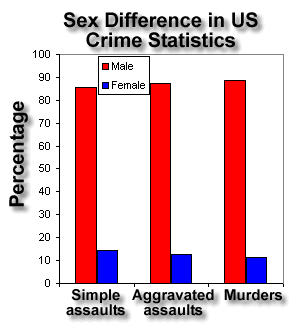 |
Over
80% of homicides are committed by men .
Most of
the victims are also men. The most common cause of homicide is due to
the escalation of a relatively trivial disagreement over status that
starts with words and escalates into lethal violence. It seems that men
resort to violence to protect or gain status and honour.
This
sex difference is found across all cultures. Criminal violence is most
likely between the ages of 14 and 24.
Traditional
psychologists argue that boys are trained to be aggressive and girls
learn to be passive. However, Dyson-Hudson (1995) found that
'low-conflict societies' with affectionate socialization and aversion
to inter-personal confrontation (e.g. Inuit, !Kung Bushmen, Gebusi of
lowland New Guinea) have high rates of violent death. In contrast,
Turkana pastoralists (East Africa) are taught to fight as children; and
most men reported having participated in inter- personal fights
intended to cause injury, having engaged in recreational within-group
fighting mimicking warfare, and having taken part in raids on the
neighboring Pokot. Yet demographic data indicate that within- group
homicide rates among the 'violent' Turkana are lower than those
reported for the 'low-conflict' societies.
It
may be that Turkana rules which require bystander intervention and
adjudication by elders, are effective in preventing within-group
aggression and violence from escalating into lethal fights.
|
Male aggression
 Richard
Wrangham (Wright and
Wrangham, 1998) presents an interesting analysis of male violence in
terms of evolutionary
psychology. He argues that:
Richard
Wrangham (Wright and
Wrangham, 1998) presents an interesting analysis of male violence in
terms of evolutionary
psychology. He argues that:
- Chimpanzees
and humans are the only species in which groups of males hunt and kill
members of their own species. In the Scientific
American Frontiers video (2001) "Chimps
Observed", Goodall describes her work, and discusses the
implications of lethal intraspecific aggression in chimps
- therefore murder is not a
unique 'culturally determined' human
behaviour
- Chimpanzees patrol their
territorial borders in a group and will kill an isolated
animal from a neighbouring group. Under these circumstances there is little
risk that the aggressor will be seriously injured
whereas the victim will either be killed, or seriously harmed.
- Some forms of human
violence involve an accurate assessment of the risk of injury (e.g. the
Mafia are reputed to wait for a numerical advantage before they attack
their victim).
 However
warfare is a uniquely human behaviour.
In a battle both sides will
suffer casualties regardless of who finally wins. Consequently battles
involve a failure
to assess the true costs of combat by both sides. Wrangham suggests
that this failure is
due to 'positive illusions' by each set of
combatants that they will
emerge victorious
However
warfare is a uniquely human behaviour.
In a battle both sides will
suffer casualties regardless of who finally wins. Consequently battles
involve a failure
to assess the true costs of combat by both sides. Wrangham suggests
that this failure is
due to 'positive illusions' by each set of
combatants that they will
emerge victorious
Female aggression
Until recently, relatively
little attention was focussed on female
aggression. Campbell (1999) argues that
".. lower rates of
aggression by women reflect not just the absence of masculine
risk-taking but are part of a positive female adaptation driven by the
critical importance of the mother's survival for her own reproductive
success."

|
Campbell
reviews evidence that:
- women show
greater fear of physical harm compared to men.
For example:
- women show more
fear of open spaces, dogs, snakes, insects, and rodents than men
- women
are less likely to engage in hazardous sports, dangerous driving,
military combat, and drug abuse, than men
- women are more
afraid of being victims of crime involving aggression, and are more
likely to visit a doctor to seek advice on preventative care, than men
- women commit fewer
violent crimes than men (see Campbell et al, 2001)
- women show less
concern for status compared to men
- greater adoption of
dispute resolution strategies that involve a low risk of physical harm
by women compared to men
- female 'maternal
aggression' to defend their offspring; paternal aggression is rarer
- female menopause - an
infertile period after the birth of the last child will ensure its
survival
This is a picture of Phoolan Devi, (Seema Biswas)
so-called "Bandit Queen of India", she led a gang who roamed
north central India during the late 1970s and early 1980s; she became a
folk hero after taking bloody revenge against men who raped her.
|
|
These
stills are taken from the French film 'Baise Moi" which was banned in
several countries. The film deals with a young woman who has been
raped, and an accomplice, who embark on a spree of violence and
promiscuous sex. It is interesting to reflect on this film's treatment
by censors in the light of Campbell's argument that
"...Women's aggression
has been viewed as a gender-incongruent aberration or dismissed as
evidence of irrationality. These cultural interpretations have
"enhanced" evolutionarily based sex differences by a process of
imposition which stigmatises the expression of aggression by females
and causes women to offer exculpatory (rather than justificatory)
accounts of their own aggression."
|
 |
 |
Hormones
& Aggression
Testosterone
and aggression in rodents
Testosterone
is an androgen . It is
made by Leydig cells in the male testis, as well as the adrenal cortex
and ovary of both
sexes .Testosterone in men is secreted into the bloodstream in spurts,
so levels can
change dramatically within minutes. The hormone is released in a
circadian rhythm in both
sexes, highest and most variable in the morning, lower and more stable
during the
afternoon. Synthetic testosterone such as testosterone propionate is a
synthetic drug
which is absorbed more easily, and has longer lasting effects than the
naturally occurring
hormone.
Testosterone
has
- androgenic
(masculinizing) effects
- anabolic
(protein tissue building) exploited by athletes to build
muscle mass, reduce fat, and improve performance
There
is evidence that androgens affect
aggression:
- aggression
and androgen levels covary on a seasonal basis -e.g. red deer
- aggression
increases with increased levels of androgen at puberty
- generally
males are more aggressive than females
Experiments
in rodents suggest that androgens
increase aggression in male and female mice
Male
aggression & testosterone

Redrawn
from Wagner et al (1980)
|
In
male mice
- castration
reduces aggression
- testosterone
restores aggression in castrated mice
- androgens
have an organizational effect on aggression in infancy
- exposure
to androgens in infancy increases the sensitivity of the adult brain to
androgen
There
is evidence that high levels of testosterone are necessary but
not sufficient to trigger aggression. There
are individual differences in the aggressive behaviour of mice. In one
experiment male mice were rated as aggressive or non-aggressive. They
were then castrated which reduced their aggression. When they were
given testosterone replacement therapy, only those mice who were
initially rated as aggressive showed a restoration of aggressive
behaviour. In other words testosterone is necessary for aggressive mice
to exhibit aggression, but injecting testosterone is not sufficient to
turn a previously non-aggressive mouse into an aggressive mouse.
Can
you think of an explanation for this finding based on the idea that
early exposure to testosterone organizes the brain?
|
Female
aggression & testosterone

Redrawn
from Carlson (1998)
|
In
female mice
- testosterone
- but not oestrogen - increases aggressiveness in ovariectomised
females (van de Poll et al, 1988)
- exposure
to androgens prenatally - due to intrauterine position - increases
aggressiveness in adulthood
|
Hormones
and human aggression
Nelson
(1995) reviews the relationship
between hormones and aggression in humans. Unlike the animal studies we
have reviewed,
these studies rely on interviews, questionnaires or criminal records to
assess aggressive
behaviour.
One
problem in this area is the time that
elapses between the aggressive act(s) and the analysis of hormone
levels. Nevertheless it
does appear that there is a positive correlation between violence in
male and female
prisoners and circulating levels of androgen. But it is unclear whether
androgens:
- facilitate
aggression or,
- encourage
social dominance, competitiveness, and impulsiveness
Mazur
& Booth ( available
online )
argue that "high levels of endogenous testosterone (T) seem to
encourage behavior
apparently intended to dominate -- to enhance one's status over --
other people. Sometimes
dominant behavior is aggressive, its apparent intent being to inflict
harm on another
person, but often dominance is expressed nonaggressively. Sometimes
dominant behavior
takes the form of antisocial behavior, including rebellion against
authority and law
breaking... T not only affects behavior but also responds to it. The
act of competing for
dominant status affects male T levels in two ways. First, T rises in
the face of a
challenge, as if it were an anticipatory response to impending
competition. Second, after
the competition, T rises in winners and declines in losers. Thus, there
is a reciprocity
between T and dominance behavior, each affecting the other. "
There
may be important individual
differences in our response to testosterone. In a recent
report Harrison et al (2000)
administered testosterone to 56 men aged 20 to 50 years. Testosterone
treatment
significantly increased aggressive responses on a frustration-inducing
computer game
involving a fictitious subject. This effect, however, was not uniform
across individuals;
most showed little psychological change, whereas a few developed
prominent effects.
Androgens
and sport
- testosterone
increases before competition - an anticipatory response
- winning
appears to increase testosterone level
- loosing
reduces testosterone level
- these
effects are also seen in sports fans
- effects
seen in non-physical games e.g. chess
It is
possible that these effects are due to
changes in status because:
- testosterone
increases in students after graduation,
- and
in hostages after their release from captivity
Consequently
these effects may be related to
changes in dominance. Jeffcoate et al (1986) found that testosterone
level changed in men
as a function of their changing dominance-ranking within a group aboard
a holiday yacht.
'Basal'
and 'Reciprocal' Models of
Testosterone Effects on Behaviour
It is
difficult to know whether testosterone causes
changes in a person's dominance - the basal model
, or if testosterone levels vary
as a function of a person's position within a dominance ranking - the reciprocal
model.
According
to the basal model
testosterone level is a stable trait, and
consequently it is possible to predict
behavior from testosterone measured at a single point in time. It
suggests that men with
high basal testosterone level engage in dominating or antisocial
behavior.
Mazur
& Booth ( available
online )
review studies showing that men with higher levels of testosterone are
more likely to:
- divorce,
or remain single
- be
arrested for offenses other than traffic violations,
- to
buy and sell stolen property,
- incur
bad debts
- use
a weapon in fights
According
to the reciprocal model
testosterone levels vary as a function of a
person's dominance.
In a
study of marital status among 2,100 male
Air Force veterans who received four medical examinations over a ten
year period,
testosterone levels fell and remained low with marriage, and rose with
divorce. These
results are consistent with the reciprocal model (Mazur & Booth
available
online )
Neurotransmitters
& Aggression
Serotonin
and aggression- animal studies
Increased
serotonergic activity tends to
reduce aggressive behaviour in rodents.
- Isolation-induced,
resident-intruder and maternal aggression reduced by 5-HT agonist drugs
(agonists increase activity at neurotransmitter receptor sites )
- mutant
mice lacking the 5-HT 1B receptor gene show decreased attack latency,
and an increased number of attacks in the isolation-induced aggression
model (see Fig. 9.24 Feldman et al (1997)
Adapted
from Fig 11.18 Carlson (1998)
|
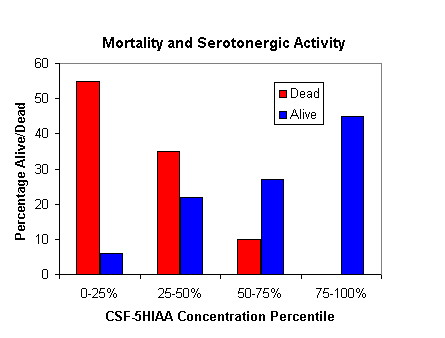
Higley et al (1996)
studied free-ranging rhesus monkeys living on an island. Used
behavioural observations and sampled CSF (cerebro spinal fluid) to
measure 5-HIAA levels (5-HIAA is a breakdown product of 5-HT - the more
5-HIAA the greater 5-HT release).
- found
negative correlation between 5-HIAA and aggression. No relationship
between aggression and NA or DA metabolites.
- Low
5-HIAA associated with high risk-taking behaviour -aggression towards
older larger animals, took long leaps from tree to tree. Many died as a
result of attacks from mature males.
- low
5-HT turnover may reflect low impulse control rather
than increased aggression per se
|
| "Dominance and
aggression are not synonymous." (Carlson,1998) |

(Sir
Edwin Landseer.
The Monarch of the Glen. 1851)
|
 |
Serotonin
levels are affected by dominance
rank. Raleigh et al, (1984)
- 5-HT
level is higher in dominant than subordinate male vervet monkeys
- Removing
dominant male changes dominance hierarchy within remaining animals.
- New
dominant male shows increase in his 5-HT level.
- Restoring
previously dominant male provokes restores original 5-HT levels.

Redrawn
from Fig 9.25 Feldman (1997)
|
Raleigh et al (1991) investigated effects of serotonergic drugs on
dominance and aggression. Used 12 groups of vervet monkeys. Temporarily
removed dominant male from each group. The two remaining subordinate
monkeys were treated with
- serotonergic
drug
- control
(placebo)
The
serotonergic drugs used were
- 5-HT
agonists (tryptophan or fluoxetine)
which increase 5-HT activity
- 5-HT
antagonists (cyproheptadine or
fenfluramine) which decrease 5-HT activity (chronic treatment with
fenfluramine depletes 5-HT levels )
Used
a crossover design so that each monkey received
agonist and antagonist treatments.
Results:
- monkeys
given agonist drugs became dominant
- monkeys
given antagonist drugs became subordinate
- monkeys
given agonist drugs initiated fewer aggressive
events
- monkeys
given antagonist drugs initiated more aggressive
events
Note
that because a cross over design was used the same animal could be
dominant or subordinate depending on what type of serotinergic drug
they received.
|
Serotonin and human aggression
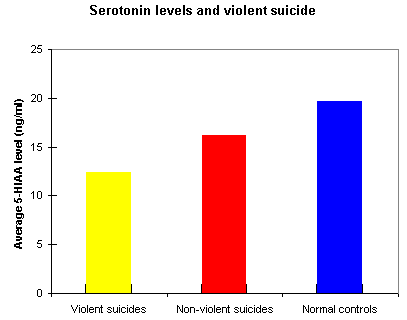 |
- Reduced
concentrations of 5-HT and 5-HIAA in brains of suicide victims.
- Maybe
suicide and violence towards other people represent the same underlying
aggressive tendency
- Low
5-HIAA levels in brains of suicides who used violent means to end their
own lives (using guns or jumping from heights rather than by ingesting
pills or taking a poison)
- in
normal adults there is a negative correlation between 5-HIAA level and
'urge to act out hostility' subscale of the Hostility and Direction of
Hostility Questionnaire
- in
psychiatric patients there is a negative correlation between 5-HIAA
level and psychological measures of aggression
- low
5-HIAA linked to impulsive, antisocial aggressiveness
- low
5-HIAA reported in children with disruptive behaviour
|
Fenfluramine
challenge
 |
The release of the
hormone prolactin from the pituitary gland is controlled by serotonin.
The
drug fenfluramine:
- releases
5-HT from presynaptic terminals
- which
in turn increases the release of prolactin from the pituitary into the
blood stream
The
amount of prolactin released by a fixed dose of fenfluramine varies
between individuals. Measuring the amount of prolactin released by
fenfluramine (fenfluramine challenge) is used an an index of the status
of the 5-HT system. Coccaro et al (1989) studied male patients with
personality disorders. Patients were given a fixed 'challenge' dose of
fenfluramine. Blood samples were taken and analysed for prolactin
levels.
There
was a significant negative correlation between prolactin concentration
scores on BDHI (Buss-Durkee Hostility Inventory) subscales which
measure irritable, impulsive aggression . The more
aggressive patients showed an attenuated response to fenfluramine
suggesting that they had reduced serotonergic activity.
This
result is consistent with a picture of low serotonin activity being
associated with increased aggressive and impulsive behaviours.
|
Pharmacological treatment of aggression
 |
It may be possible to
treat aggression by increasing serotonergic activity by administering
the antidepressant drug Prozac (fluoxetine) which is a 5-HT reuptake
inhibitor (Coccaro & Kavoussi, 1997) |
Serotonin
and mood: Conclusions
- aggressiveness
per se not associated with low CSF 5-HIAA levels
- low
5-HIAA may be associated with impulsivity, hyperirritability, suicide,
depressed mood and heightened anxiety
Neuropsychology
of Aggression & Fear
Brain
and aggression
Hypothalamus
- Bard
& Mountcastle in the 1940s studied rage in cats with lesions
that detached 'higher' from 'lower' parts of the brain.. They concluded
that the hypothalamus organizes attack behaviour and the cerebral
cortex normally inhibits the release of aggression
- In
the 1960s Flynn found that electrical stimulation of lateral
hypothalamus elicits predatory aggression in cats, whereas stimulation
of the medial hypothalamus elicited vicious attack behaviour.
- increased
irritability associated with hypothalamic tumours in humans
Amygdala
- lesioning
amygdala has 'taming' effect in animals - The Kluver-Bucy Syndrome 1939
- the
role of the amygdala is complex. Some studies report that amygdalectomy
increases aggression others report that it has a taming effect. The
amygdala may modulate output from the hypothalamus. Eggar &
Flynn found that (1) attack behaviour produced by stimulating the
hypothalamus can be inhibited by stimulating the basomedial nucleus of
the amygdala. (2) attack behaviour produced by stimulating the
hypothalamus can be facilitated by stimulating the lateral nucleus of
the amygdala.
- amygdalectomy
reduces violent human behaviour - side effect - loss of emotion
- temporal
lobe epilepsy - which involves the amygdala - can involve violent
behaviour
- rabies
is caused by a virus that damages the temporal lobe. Rabid animals are
violently aggressive.
- amygdalectomy
can disrupt dominance hierarchies in monkeys - Pribram, 1962.
- Autopsies of Charles
Whitman who carried out a sniper attack from the University Tower at
Texas in 1966, showed he had a tumor pressing on his amygdala.
Fear
and the amygdala
 The central nucleus of
the amygdala may be a control
centre for fear, receiving fear-related sensory information and
transmitting fear-related
motor instructions.
The central nucleus of
the amygdala may be a control
centre for fear, receiving fear-related sensory information and
transmitting fear-related
motor instructions.
LeDoux
(1994) suggests that the amygdala
receives input from three areas:the thalamus, cortex and the
hippocampus
Online
resources
Biology
of Aggression. (1995) This hour long radio programme discuss
the causes of violent behavior, which is on the rise among teenagers in
the U.S. Is this due to increased family violence at home, or does
genetics play a role? Participants: Adriane Raine, University of
Southern California, Dorothy Nelkin, New York University, Craig Ferris,
University of Massachusetts
Campbell
(1999). Staying alive: Evolution, culture and
women's intra-sexual aggression. Behavioural and Brain
Sciences, 22, 203-252
Campbell, Muncer
and Bibel (2001). Women and crime: An evolutionary feminist
approach. Aggression and Violent Behavior,
6, 481-497
Arendal
The Emotional Brain (2000).
Discusses the idea that fear been hardwired into our brains over the
course of evolution, and Joseph LeDoux's theory of
emotion - Schaffhausen
Fear Conditioning:How the Brain Learns about
Danger. Discusses specific brain areas (amygdala and
hippocampus) that govern fear responses and learning
to fear.
- Azar
Exposure
to aggression may have lasting effects APA Monitor Online
VOLUME 30 , NUMBER 9 October 1999. After
aggressive encounters levels of dopamine and serotonin rise
and fall respectively in specific brain areas of victors and losers.
- Benson. More male
than male. APA Monitor Online. Volume 33, No. 9 October 2002
"New research is confirming the
relationship between steroids and aggression, while raising questions
about the long-term psychological consequences of teen-age steroid
abuse. Do steroids increase aggression, or is the apparent
aggressiveness of steroid users simply a result of competitive gym
rooms and the personalities of the bodybuilders who use them? " more ...
- Scientific
American Frontiers (2001) "Chimps Observed" video
available online
- Seville Statement on Violence.
Spain 1986 (Subsequently adopted by UNESCA at the 25th session of the
General Conference on 16 November 1989).
- Wright and
Wrangham, (1998) Morals, Demonic Males and Evolutionary
Psychology. In Information and Biological Revolutions: Global
Governance Challenges--Summary of a Study Group by Francis Fukuyama
Caroline S. Wagner. This project was conducted in RAND's Science and
Technology Policy Institute
References
- Anderson,
Psychological Bulletin , 106, 74-96, 1989
- Atzwanger
, Paper
presented at the Human Behavior and Evolution Conference, Santa
Barbara, June 1995
- Booth
and Dabbs, Social Forces 72: 463-477, 1993
- Brain,
Multidisciplinary Approaches to Aggression Research ,
Brain & Benton (Eds), Elsevier/North Holland, Amsterdam, 1981.
- Campbell (1999). Staying
alive: Evolution, culture and women's intra-sexual aggression.
Behavioural and Brain Sciences, 22, 203-252, available online
- Carlson,
Physiology of Behavior , 6th Ed Allyn &
Bacon, Boston, 1998
- Coccaro
et al, Archives of General Psychiatry , 46,
587-599, 1989
- Dyson-Hudson
, Paper
presented at the Human Behavior and Evolution Conference, Santa
Barbara, June 1995
- Feldman
et al, Principles of Neuropsychopharmacology, Sinauer, Sunderland, MA.,
1997
- Hansen
& Hansen, Journal of Personality and Social Psychology, 54,
917-924, 1988
- Harrison
et al, Archives of General Psychiatry ,Vol. 57 No.
2, February 2000
- Higley
et al, Archives of General Psychiatry , 53,
537-543, 1996
- Jeffcoate
et al Journal of Psychosomatic Research , 30,
217-222, 1986
- Mazur
& Booth, Behavioural and Brain Sciences, 21, 353-397, available
online
- Morris,
Manwatching , Jonathan Cape, London, 1977
- Morris,
Animal Watching: A Field Guide to Animal Behaviour ,
Jonathan Cape, London, 1990
- Moyer,
Communic. Behav. Biol . A, 2, 65-87 ,
1968
- Nelson,
An Introduction to Behavioral Endocrinology,
Sinauer, 1995
- Nemeroff,
The Biology and Mechanism of Aggression, available
online
- Raleigh
et al, Archives of General Psychiatry , 41,
405-410, 1984
- Raleigh
et al, Brain Research , 559, 181-190 ,
1991
- van
de Poll et al, International Journal of Neuroscience ,
41, 271-286, 1988
- Wagner
et al, Aggressive Behavior , 6,1-7, 1980
- Wright and Wrangham, (1998)
Morals, Demonic Males and Evolutionary Psychology. In Information and
Biological Revolutions: Global Governance Challenges--Summary of a
Study Group by Francis Fukuyama Caroline S. Wagner. This project was
conducted in RAND's Science and Technology Policy Institute. Available online
Copyright Dr.
C.A.P. Kenyon 1994-2006


